Guide
The Subject Teacher's Role in Assessment Arrangements
A practical guide for subject teachers on their role in identifying need, gathering evidence and supporting assessment arrangements.
Assessment arrangements are everyone's responsibility
One of the most common misconceptions in schools is:
Assessment arrangements are dealt with by the ASN team.
In reality, successful assessment arrangements depend on the contribution of every subject teacher.
Support for Learning (SfL) staff coordinate processes, provide advice and oversee evidence gathering, but they do not see learners every day in every classroom.
Subject teachers are uniquely placed to identify barriers because they:
- understand the demands of their subject
- observe learners regularly
- know what successful performance looks like
- see how learners respond to different types of support
Without subject teacher evidence, it is difficult to demonstrate that an assessment arrangement reflects a learner's normal way of working.
Why every teacher matters
Every subject places different demands on learners.
A learner may experience significant barriers in one subject but very few in another.
For example:
- English requires extended writing.
- Mathematics often requires concise written responses.
- Modern Languages may involve listening and speaking assessments.
- Practical subjects may place greater emphasis on demonstration than written work.
Only the subject teacher can explain how the learner's difficulty affects assessment within that specific context.
This is why Qualifications Scotland expects assessment arrangements to be considered subject by subject, rather than applying the same support automatically across every course.
Subject-specific evidence
Evidence should explain how the learner's difficulty affects assessment in your subject.
Rather than describing the learner's diagnosis, focus on what you observe.
Ask yourself:
- What barrier does the learner experience?
- When does it occur?
- What support do I normally provide?
- Does the support improve access?
- Is the learner working more independently?
Your observations become part of the overall evidence profile that supports decision-making.
Different needs in different subjects
The same learner may require different levels of support depending on the assessment demands.
Example
Claire has dyslexia.
In Higher English, she struggles to complete extended essays within the allocated time and regularly benefits from 25% extra time.
In Higher Mathematics, most responses are shorter and require less sustained writing. Her teacher finds that 15% additional time is sufficient.
Neither teacher is "more correct."
Each has considered the learner's needs within the context of their own subject.
This is exactly what good practice looks like.
What should subject teachers record?
Evidence does not need to be lengthy.
Short, specific observations recorded consistently throughout the year are usually more valuable than long reports completed at the end of the session.
A useful observation includes:
- the task completed
- the barrier observed
- the support provided
- the outcome
For example:
During today's timed source analysis, Jamie required text-to-speech software to access the written material independently. Without it, they struggled to read the sources within the allocated time.
This tells a much clearer story than simply recording:
Jamie used text-to-speech.
Writing meaningful teacher comments
Teacher comments should explain why support is appropriate.
Avoid generic statements.
Instead of this...
Sophie has dyslexia and needs extra time.
Write this...
Sophie consistently requires additional time to complete extended writing tasks. During class essays she typically completes around three-quarters of the response within the allocated time. When provided with 25% additional time she completes her work independently without any reduction in quality.
The second example provides evidence rather than opinion.
Recording classroom support
Support should be recorded whenever it forms part of the learner's normal classroom practice.
This might include:
- ICT used for written work
- Text-to-speech software
- Speech recognition
- Extra time
- Rest breaks
- Prompting
- Alternative seating
- Separate working areas
- Enlarged materials
The important question is:
Does this reflect the learner's usual way of working?
If the answer is yes, it should be recorded.
A simple recording template
Many schools use a consistent format across departments.
| Record | Example |
|---|---|
| Task | Timed persuasive essay |
| Barrier | Unable to complete writing in allocated time |
| Support | 25% additional time |
| Outcome | Essay completed independently with improved quality |
| Teacher comment | Additional time reflected normal classroom practice |
Brief notes like these quickly build a strong evidence profile over time.
Good examples
Example 1 — Extra time
During three timed writing tasks this term, Leah completed approximately 75% of each task within the allocated lesson. With 20 minutes of additional time she completed all three independently. The additional time has become part of her normal classroom support.
Example 2 — Text-to-speech
Oliver independently uses text-to-speech software for all extended reading tasks in Geography. Without this support he struggles to access lengthy written sources within lesson time.
Example 3 — Separate accommodation
During assessments, Aisha becomes distracted by classroom noise and frequently stops working. Completing assessments in a quieter room has significantly improved her concentration and independence.
Each example explains:
- the barrier
- the support
- the impact
Poor examples
Example 1
Uses extra time.
This tells us nothing about why.
Example 2
Dyslexic.
A diagnosis is not evidence.
Example 3
ASN requested ICT.
This explains who made the decision but not why it is appropriate.
Example 4
Requires support.
Support for what?
How does it help?
What difference does it make?
Evidence should always explain these questions.
Working with Support for Learning
Assessment arrangements work best when subject teachers and SfL work together.
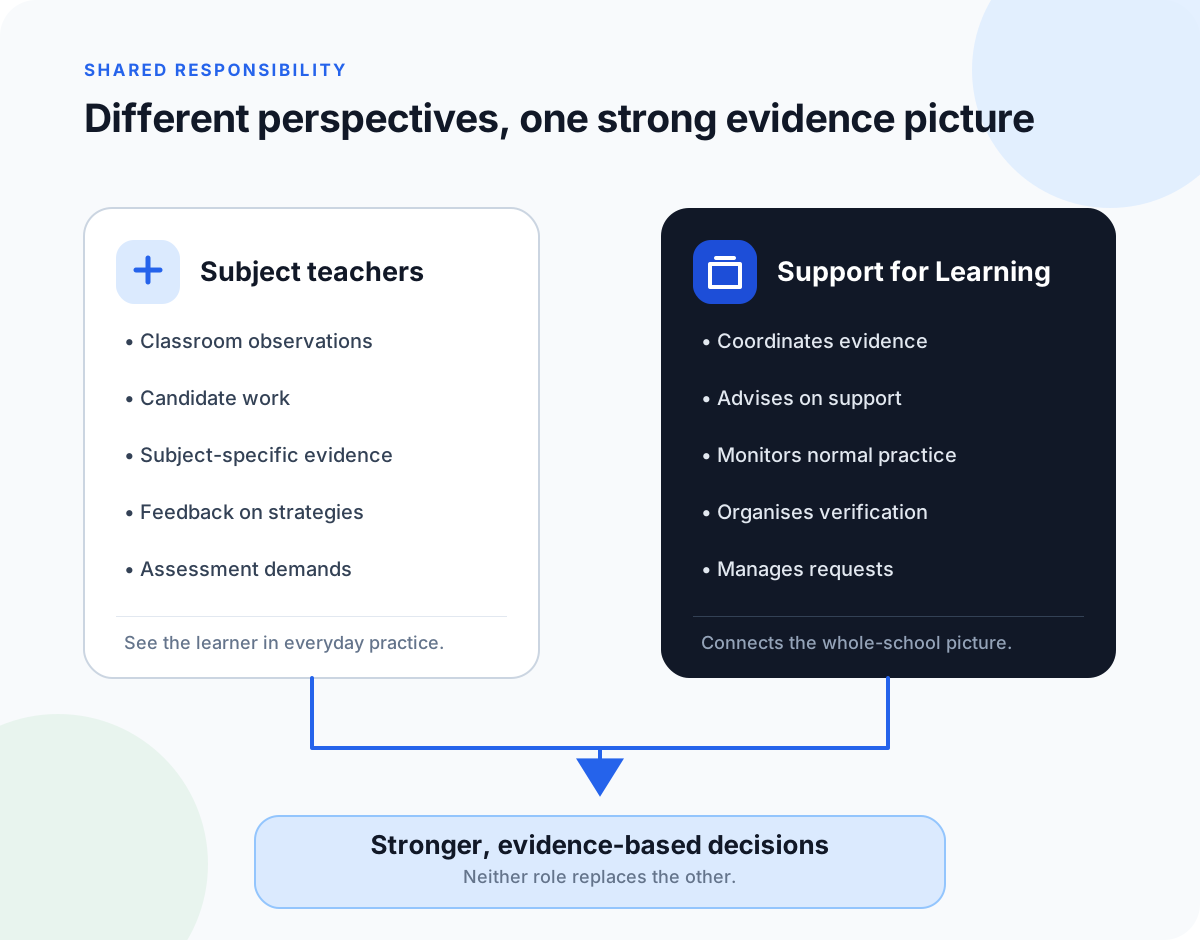
Neither role replaces the other.
Strong collaboration produces better decisions and stronger evidence.
Questions every subject teacher should ask
Before recommending an assessment arrangement, consider:
- What barrier does this learner experience in my subject?
- Does the learner receive this support routinely?
- Have I observed that the support improves access?
- Would another subject teacher observe something different?
- Have I recorded my observations clearly?
If you can answer these questions confidently, your evidence is likely to support effective decision-making.
A wider school-level framework is set out in 10 Questions to Ask Before Recommending an Assessment Arrangement.
Key messages
- Assessment arrangements are a whole-school responsibility.
- Subject teachers provide essential evidence that no one else can.
- Evidence should focus on barriers, support and outcomes.
- Different subjects may require different assessment arrangements.
- Short, regular observations are more valuable than lengthy reports completed retrospectively.
- Good teacher comments explain why support is appropriate, not simply what was provided.
Continue building effective classroom practice by reading Building Normal Way of Working Throughout the Year and Choosing the Right Assessment Arrangement.