Guide
Gathering Good Evidence
A practical guide to collecting meaningful evidence that supports assessment arrangements through everyday learning, teaching and assessment.
Good evidence tells a story
One of the biggest challenges for schools is knowing what good evidence actually looks like.
Many teachers hear the advice:
Collect evidence.
But evidence is much more than keeping examples of classwork.
Good evidence explains:
- the barrier the learner experiences
- the support that was provided
- whether it made a difference
- whether the support has become part of the learner's normal way of working
Taken together, this builds a clear picture of why an assessment arrangement is appropriate.
What counts as good evidence?
Good evidence is gathered naturally through everyday teaching and learning.
It should demonstrate three things:
- The learner experiences a barrier.
- Support has been provided.
- The support improves access to learning or assessment.
Evidence should come from a range of sources rather than relying on a single document.
Examples of useful evidence
- Classroom observations
- Teacher records
- Candidate work
- Timed assessments
- Learner feedback
- Subject teacher comments
- Support plans
- Departmental records
- Minutes from assessment arrangement meetings
The strongest evidence shows a consistent pattern over time.
What is not good evidence?
Some commonly submitted evidence tells us very little about whether an assessment arrangement is actually needed.
The following should not be used on their own:
- A diagnosis or medical report
- An Educational Psychologist's recommendation
- A support plan without classroom evidence
- Evidence from primary school only
- "The learner has always had extra time."
- A single prelim result
- One piece of candidate work
These documents may contribute to the overall picture, but they do not demonstrate the learner's current assessment needs.
Classroom observations
Teachers see learners every day and are often best placed to identify assessment barriers.
Observations do not need to be lengthy.
A few sentences recorded regularly are usually more valuable than a long report completed once a year.
Example
Claire consistently completes approximately three-quarters of extended writing tasks within the allocated lesson. When provided with 25% additional time, she completes tasks independently and produces work that reflects her understanding of the topic.
Notice that this records:
- the barrier
- the support
- the outcome
Candidate work
Candidate work provides valuable evidence when viewed alongside teacher observations.
Useful examples include:
- Completed class assessments
- Timed writing tasks
- Practical assessment records
- Coursework completed using agreed support
- Digital work produced using assistive technology
Where possible, annotate the work to explain:
- how long the learner worked
- what support was provided
- whether the learner completed the task
The work itself is only part of the evidence.
The teacher's explanation is equally important.
Timed tasks
Timed classroom activities often provide some of the strongest evidence for arrangements such as extra time.
Rather than asking,
"Did the learner use the extra time?"
ask,
"What happened when the learner was given additional time?"
Useful evidence might show:
- how much work was completed in the allocated time
- how much was completed during additional time
- whether quality improved
- whether the learner remained independent
Remember that simply using extra time is not evidence that it is needed.
The evidence should demonstrate why it is appropriate.
Teacher comments
Subject teachers play a vital role in gathering evidence.
Good comments describe:
- the barrier observed
- the support normally provided
- whether it is effective
- why it is appropriate in that subject
Less helpful
Claire has dyslexia and should receive extra time.
More helpful
Claire rarely completes extended writing tasks within the allocated lesson despite demonstrating strong verbal understanding. Providing approximately 25% additional time enables her to complete responses independently and accurately.
Specific observations carry much more weight than general statements.
Support plans
Support plans provide useful background information but should not be relied upon in isolation.
A support plan might explain:
- identified needs
- agreed strategies
- classroom adjustments
- recommended approaches
However, schools should also be able to show that these supports are actually being used and are effective in practice.
Support plans should therefore be viewed alongside classroom evidence.
Recording evidence efficiently
Evidence gathering should not become an administrative burden.
Small, consistent records collected throughout the year are far more useful than trying to recreate evidence shortly before assessment deadlines.
A simple recording approach
| Record | Keep it brief |
|---|---|
| Date | When was the observation made? |
| Context | What lesson or assessment? |
| Barrier | What difficulty was observed? |
| Support | What support was used? |
| Outcome | What difference did it make? |
Many schools successfully record this information using existing tracking systems, learner profiles or departmental monitoring records.
Consistency matters more than the format.
Worked example: Claire
The following case study is adapted from the SQA Assessment Arrangements Toolkit and illustrates how evidence can be built across several subjects.
Step 1 — Identify the barrier
Claire has dyslexia, which affects her writing speed.
Teachers observe that she regularly struggles to complete timed written tasks despite demonstrating strong understanding during class discussions.
The diagnosis explains why the barrier may exist.
The classroom observations explain how it affects assessment.
Step 2 — Trial support
Teachers agree to provide:
- 25% extra time in Higher English and Higher History
- 15% extra time in Higher Mathematics and Higher Chemistry
The different allocations reflect the different assessment demands in each subject.
Step 3 — Gather classroom evidence
Higher English teacher records:
Claire rarely completes extended writing within the allocated time. With 25% additional time she completes tasks independently and consistently.
Higher History teacher records:
Extended essays are incomplete within the lesson allocation. Additional time allows Claire to complete her responses without reducing quality.
Higher Mathematics teacher records:
Claire generally completes calculations successfully but occasionally requires additional time to record written explanations. Fifteen per cent additional time has proved sufficient.
Higher Chemistry teacher records:
A small amount of additional time allows Claire to complete written responses during class assessments.
Each subject teacher contributes evidence based on their own classroom observations.
Step 4 — Collect supporting evidence
The school also retains:
- Annotated class assessments
- Timed classroom tasks
- Departmental observation records
- Teacher comments
- Minutes of assessment arrangement discussions
Together these demonstrate:
- the identified barrier
- normal classroom support
- subject-specific consideration
- evidence that the agreed support is effective
This creates a much stronger evidence profile than relying solely on a diagnostic report or a recommendation from another professional.
Building evidence over time
Good evidence develops gradually.
A typical journey might look like this:
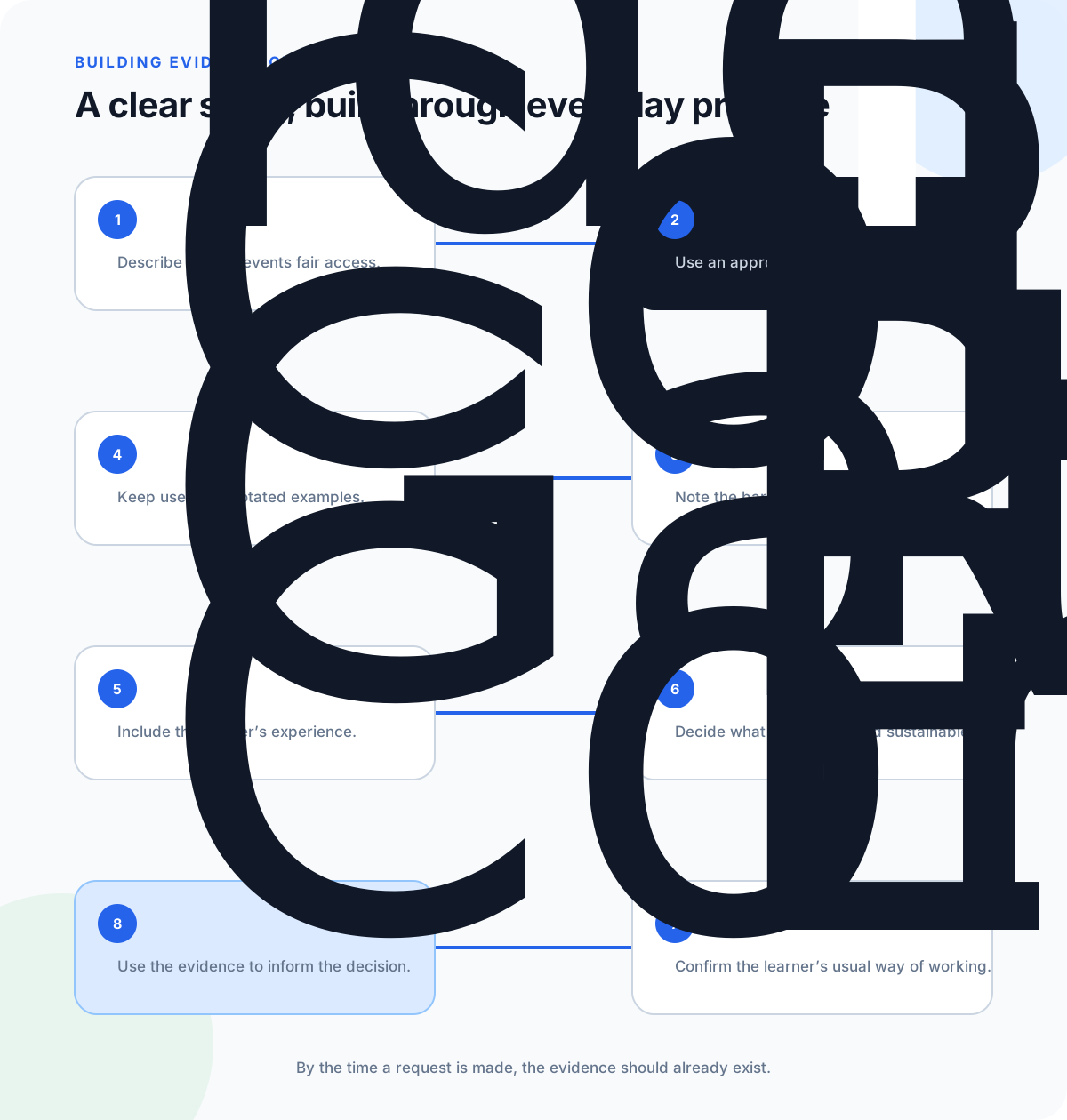
By the time an assessment arrangement is requested, the evidence should already exist.
There should be no need to gather it retrospectively.
Common mistakes to avoid
Avoid relying on:
- Diagnosis without classroom evidence.
- One piece of work.
- General statements such as "needs extra time."
- Historical evidence that has not been reviewed.
- Support that is introduced only for examinations.
- Identical evidence copied across every subject.
Good evidence is specific, current and reflects the learner's experience in each subject.
Key messages
- Good evidence explains why support is needed and how it improves access.
- Classroom observations are often the strongest source of evidence.
- Subject teachers should actively contribute evidence from their own classrooms.
- Small, regular observations are more valuable than lengthy reports written at the end of the year.
- Diagnosis supports understanding but does not replace evidence.
- Evidence should build naturally through everyday learning and assessment.
Continue building effective evidence by reading Building Normal Way of Working Throughout the Year and The Subject Teacher's Role in Assessment Arrangements.