Guide
Choosing the Right Assessment Arrangement
A practical guide to selecting assessment arrangements by identifying barriers to assessment rather than relying on diagnoses.
Start with the barrier—not the diagnosis
One of the most common mistakes when considering assessment arrangements is beginning with the learner's diagnosis.
Teachers often ask:
"Does this learner have dyslexia?"
The better question is:
"What barrier is preventing this learner from accessing the assessment?"
Assessment arrangements are designed to remove barriers to assessment. They are not awarded because of a diagnosis or medical condition.
Two learners with the same diagnosis may require completely different support. Equally, a learner with no formal diagnosis may require assessment arrangements if there is clear evidence of an assessment barrier.
The barrier should always drive the decision.
Think about the assessment, not the learner's label
Every assessment places different demands on learners.
Ask yourself:
- What is the learner struggling to do?
- Why is this happening?
- What support already helps in class?
- Does the support remove the barrier without changing what is being assessed?
Once you understand the barrier, choosing an appropriate assessment arrangement becomes much easier.
A barrier-led decision process
The following framework provides a simple starting point.
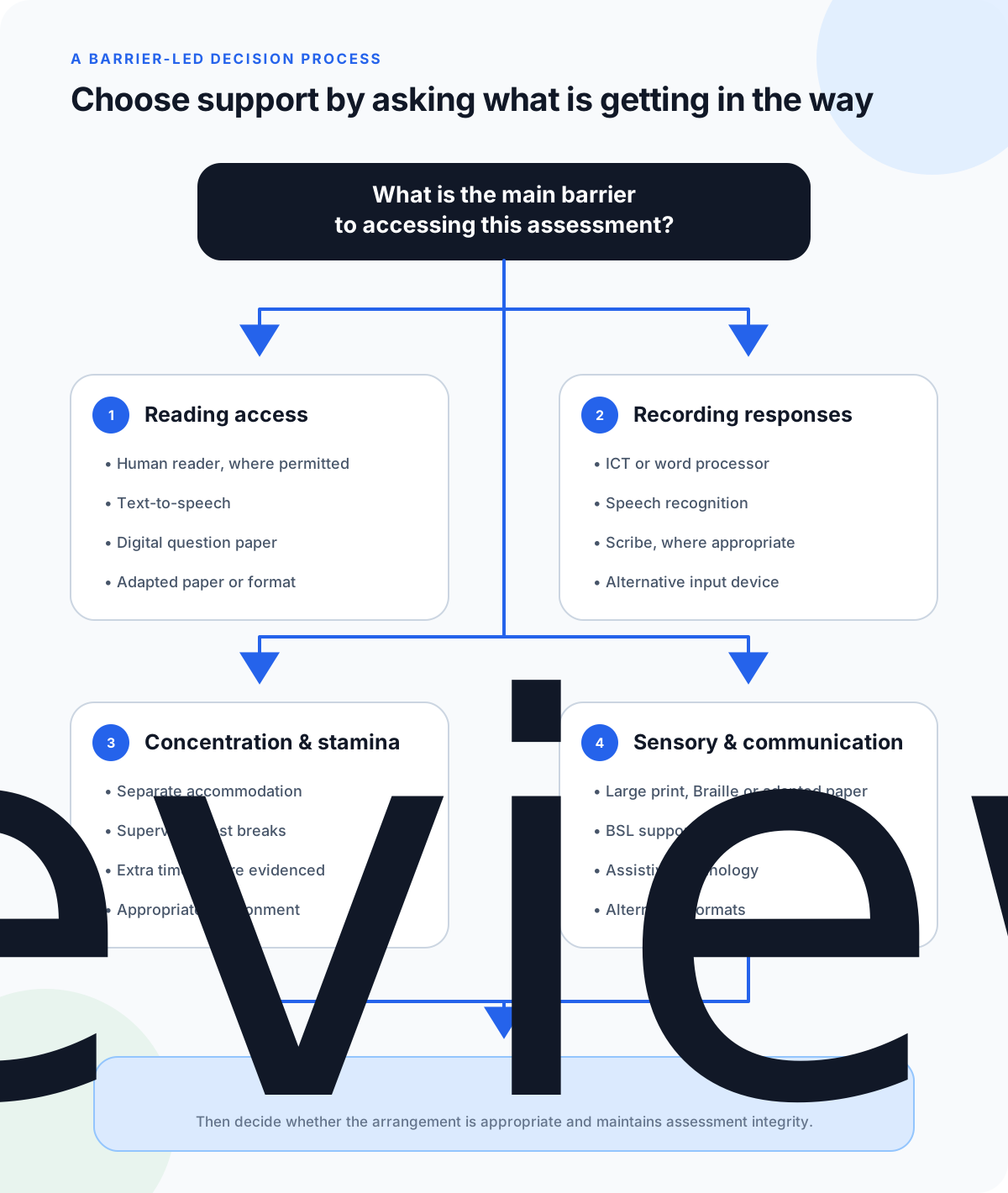
This is not a checklist. It is a guide to help identify possible arrangements that should then be trialled and supported by evidence.
Reading barriers
Some learners experience difficulty accessing written assessment materials.
This may include:
- Slow reading
- Difficulty decoding text
- Visual fatigue
- Losing their place
- Difficulty reading standard print
- Difficulty processing large amounts of written information
Possible assessment arrangements include:
- Human reader (where permitted)
- Text-to-speech software
- Digital question papers
- Adapted papers (large print, coloured paper, Braille where appropriate)
Ask yourself
- Is reading preventing the learner from accessing the assessment?
- Does the learner already use reading support during class?
- Does the arrangement improve independent access?
Remember that some assessments measure reading itself. In these cases, certain arrangements may not be appropriate.
Writing barriers
Some learners understand the subject well but struggle to record their responses.
This may be due to:
- Slow handwriting
- Poor handwriting legibility
- Physical difficulties
- Pain or fatigue
- Difficulties organising written responses
Possible assessment arrangements include:
- ICT for typing responses
- Word processing software
- Speech recognition
- Scribe (where appropriate)
Ask yourself
- Is recording responses the barrier?
- Can the learner demonstrate understanding verbally but struggle to write it down?
- Which support do they normally use?
The arrangement should remove the barrier without changing the assessment standard.
Concentration, attention and stamina
Some learners experience barriers because maintaining concentration during assessment is difficult.
Possible reasons include:
- ADHD
- Anxiety
- Mental health conditions
- Medical conditions
- Fatigue
- Chronic pain
- Medication effects
Possible assessment arrangements include:
- Separate accommodation
- Supervised rest breaks
- Extra time (where evidence shows this is needed)
Ask yourself
- Does the learner lose concentration because of the assessment environment?
- Would breaks improve access?
- Is extra time needed because of slower working, or would another arrangement remove the barrier more effectively?
Extra time should never be the default solution.
Sensory and communication barriers
Some learners require adjustments because standard assessment materials are inaccessible.
Examples include:
- Visual impairment
- Hearing impairment
- Physical disabilities
- Communication difficulties
Possible assessment arrangements include:
- Adapted papers
- Braille
- Large print
- Coloured papers
- British Sign Language support
- Assistive technology
- Alternative input devices
The arrangement should allow the learner to access the assessment in an equivalent way to their peers.
Some barriers need more than one arrangement
Assessment arrangements are not always used in isolation.
For example:
A learner with dyslexia may use:
- Text-to-speech
- ICT
- Extra time
A learner with cerebral palsy may use:
- Speech recognition
- Rest breaks
- Adapted workstation
A learner with visual impairment may use:
- Digital question papers
- Screen magnification
- Large print
The combination should reflect the learner's normal way of working.
Why diagnosis should never drive the decision
Consider these two learners.
Learner A
Has dyslexia.
Reads fluently using text-to-speech software.
Completes written work within the allocated time.
Assessment arrangement:
- Text-to-speech only.
Learner B
Also has dyslexia.
Reads independently.
Produces high-quality work but writes significantly more slowly than peers.
Assessment arrangement:
- Extra time.
Same diagnosis.
Different barriers.
Different assessment arrangements.
This is exactly how decisions should be made.
Questions to ask before choosing an arrangement
Before recommending any assessment arrangement, ask:
- What barrier is preventing access?
- What evidence do we have?
- What support already forms part of the learner's normal way of working?
- Has the support been trialled?
- Has it improved access?
- Does it maintain the integrity of the assessment?
- Is this the least intrusive arrangement that removes the barrier?
If you cannot answer these questions, more evidence may be needed before making a decision.
Work through the full framework in 10 Questions to Ask Before Recommending an Assessment Arrangement.
Common mistakes
Avoid these common pitfalls.
Starting with the diagnosis
❌ "The learner has ADHD, so they need extra time."
Instead ask:
✅ "How does ADHD affect this learner during assessment?"
Choosing the most familiar arrangement
Extra time is one of the most frequently used assessment arrangements—but it is not always the most appropriate.
Sometimes a digital paper, text-to-speech or ICT removes the barrier more effectively.
Assuming every subject needs the same support
Assessment arrangements should always be considered in the context of the assessment.
A learner may need:
- ICT for English.
- No support for Practical Cookery.
- Text-to-speech for History.
- Rest breaks during Science practical work.
Different subjects create different barriers.
Introducing support just before examinations
Assessment arrangements should never be used for the first time in an SQA assessment.
Learners should already be confident using the support during everyday learning and assessment.
Key messages
- Always identify the barrier before selecting an assessment arrangement.
- Diagnosis informs understanding but should never determine the decision.
- Different barriers require different solutions.
- The same learner may need different arrangements in different subjects.
- Trial support, gather evidence and review its effectiveness before making decisions.
- Assessment arrangements should always reflect the learner's normal way of working.
Quick reference
| Barrier | Possible assessment arrangements |
|---|---|
| Difficulty reading | Reader, text-to-speech, digital question paper, adapted paper |
| Difficulty writing | ICT, word processor, speech recognition, scribe |
| Concentration and stamina | Separate accommodation, supervised rest breaks, extra time (where evidenced) |
| Sensory or communication barriers | Adapted papers, assistive technology, BSL support, alternative formats |
Remember: There is rarely one "correct" assessment arrangement. The right choice is the one that removes the learner's barrier while maintaining the integrity of the assessment and reflects their normal way of working.
Continue reading Extra Time: Getting it Right to explore one of the most commonly used—and most frequently misunderstood—assessment arrangements.