Guide
Identifying Learners Who May Need Assessment Arrangements
A practical guide to recognising barriers to assessment and knowing when to consider assessment arrangements.
Start with the barrier, not the label
One of the most common questions teachers ask is:
"How do I know if a learner needs assessment arrangements?"
The answer is simple:
Start by identifying the barrier the learner experiences when accessing assessment, rather than looking for a diagnosis or medical label.
Some learners with a recognised diagnosis may require no assessment arrangements at all, while others with no formal diagnosis may experience significant barriers that require support.
The key question is always:
What is preventing this learner from demonstrating their knowledge, skills and understanding?
Signs teachers should notice
Teachers are often the first people to notice when a learner is struggling to access assessment.
Look for patterns rather than isolated incidents.
Reading
The learner may:
- Read significantly more slowly than peers.
- Frequently lose their place.
- Avoid reading aloud.
- Misread questions despite understanding the content.
- Become fatigued during reading-heavy tasks.
Writing
The learner may:
- Rarely finish written tasks.
- Produce much shorter responses than expected.
- Have ideas they can explain verbally but struggle to record.
- Tire quickly when writing.
- Experience pain or discomfort when handwriting.
Processing information
The learner may:
- Need repeated instructions.
- Require additional thinking time.
- Miss important details in assessment questions.
- Become overwhelmed by lengthy instructions.
- Struggle to organise responses.
Concentration
The learner may:
- Lose focus during longer assessments.
- Be distracted by classroom noise.
- Require regular prompts to remain on task.
- Perform much better in quieter environments.
Communication
The learner may:
- Find it difficult to explain answers verbally.
- Misinterpret questions.
- Need clarification of task instructions.
- Experience anxiety when speaking during assessments.
Look beyond diagnoses
Assessment arrangements are not diagnosis-led.
A diagnosis helps explain why a learner may experience barriers, but it does not determine whether assessment arrangements are appropriate.
For example:
| Diagnosis | Possible outcome |
|---|---|
| Dyslexia | May require text-to-speech, extra time or no assessment arrangements depending on need. |
| ADHD | May benefit from supervised breaks, separate accommodation or no additional support. |
| Autism | May require adjustments for sensory or communication barriers, or none at all. |
| Cerebral palsy | May use ICT or speech recognition to record responses. |
Equally, a learner may have no diagnosis but still experience barriers that require assessment arrangements.
Evidence of current classroom need is always more important than the diagnostic label.
Temporary and fluctuating needs
Not all barriers are permanent.
Some learners may require assessment arrangements because of temporary or changing circumstances.
Examples include:
- Broken arm or wrist
- Recovery from surgery
- Concussion
- Temporary visual impairment
- Significant injury
- Acute illness
Some conditions also fluctuate over time.
Examples include:
- Chronic fatigue
- Migraine
- Epilepsy
- Long COVID
- Mental health conditions
- Autoimmune conditions
Assessment arrangements should reflect the learner's needs at the time of assessment, rather than assuming needs remain constant.
Mental health
Mental health difficulties can affect assessment access in many different ways.
Some learners may experience:
- Difficulty concentrating
- Slower processing
- Panic during timed assessments
- Fatigue caused by medication
- Reduced stamina
- Difficulty working in large examination venues
Support might include:
- Supervised rest breaks
- Separate accommodation
- Extra time where evidence supports its use
- Adjustments to assessment timing where appropriate
As with every assessment arrangement, decisions should be based on evidence gathered through normal learning and assessment.
Medical conditions
Medical conditions may create barriers that are not immediately obvious.
For example, learners may experience:
- Pain
- Fatigue
- Reduced mobility
- Changes in vision
- Difficulties with handwriting
- Frequent need for medication or breaks
Teachers should focus on how the condition affects assessment, rather than the medical diagnosis itself.
Neurodivergence
Neurodivergent learners may experience a wide variety of barriers.
For example:
| Possible barrier | Examples of support to consider |
|---|---|
| Slow reading | Text-to-speech or adapted materials |
| Slow writing | ICT, speech recognition or extra time where appropriate |
| Sensory distraction | Separate accommodation |
| Organisation difficulties | Clear assessment instructions and familiar routines |
| Processing difficulties | Additional time where evidence supports it |
No two neurodivergent learners are the same.
Avoid assuming that learners with the same diagnosis require identical support.
English as an Additional Language (EAL) versus Additional Support Needs (ASN)
It is important to distinguish between learners who are developing English language proficiency and learners who have additional support needs.
Learners with EAL
A learner learning English is not automatically entitled to assessment arrangements.
Support should focus on language acquisition rather than disability.
However, learners with EAL may qualify for specific assessment support where permitted within Qualifications Scotland guidance.
Learners with ASN
Assessment arrangements are considered where an identified physical, sensory, medical, behavioural, mental health or learning difficulty creates a barrier to assessment.
Some learners may have both EAL and ASN.
Each barrier should be considered separately when deciding appropriate support.
When should teachers involve Support for Learning?
Teachers do not need to solve every concern themselves.
Early discussion with Support for Learning (SfL) is encouraged whenever you notice a learner consistently experiencing barriers.
Consider involving SfL when:
- A learner repeatedly fails to finish assessments.
- Existing classroom strategies are not removing barriers.
- Support differs significantly between subjects.
- A learner reports that assessments do not reflect what they know.
- A new medical or mental health condition has emerged.
- There are concerns about future assessments.
Early conversations allow support to become part of the learner's normal way of working rather than being introduced shortly before examinations.
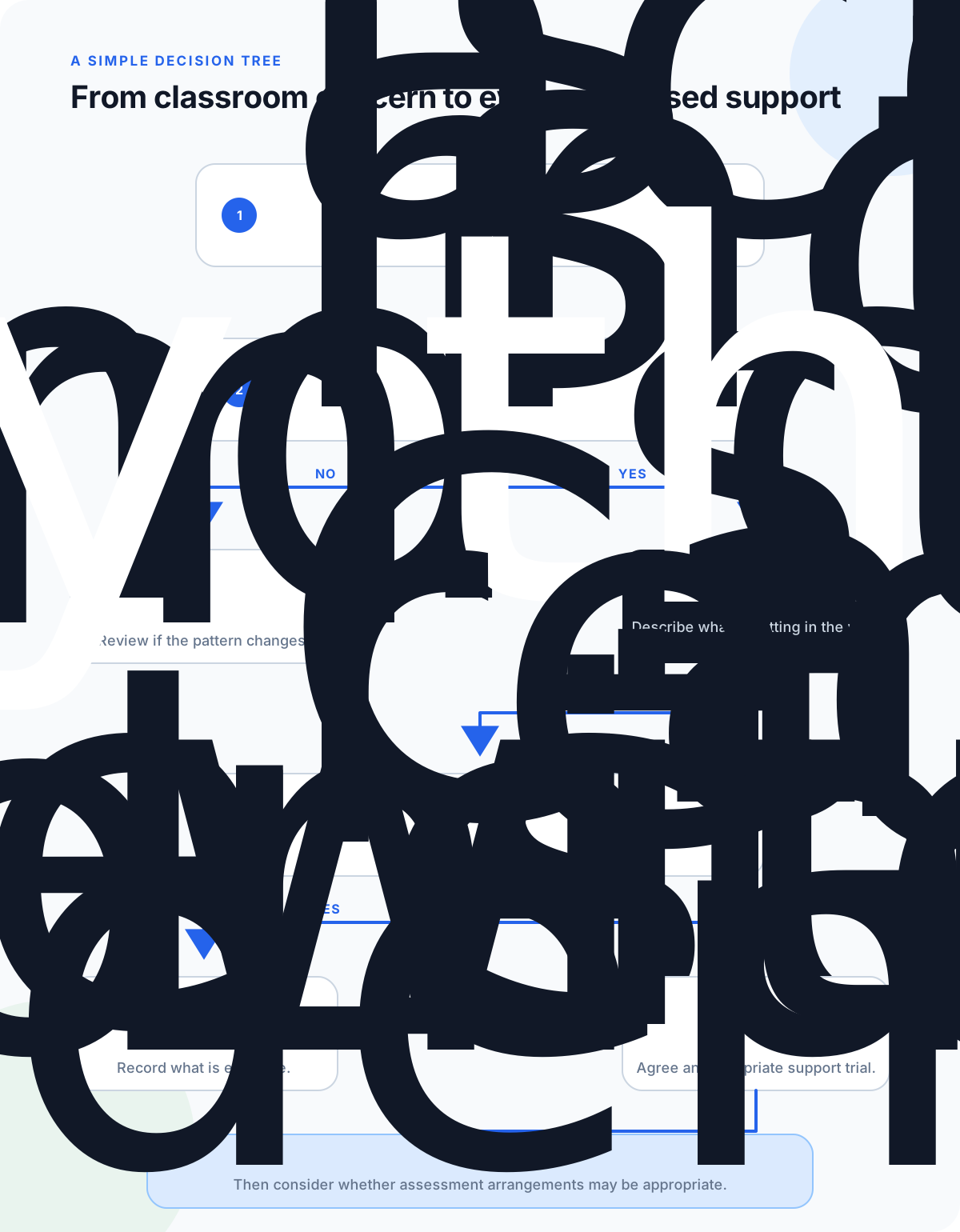
A simple decision tree
Questions teachers should ask
Before referring a learner for assessment arrangements, consider:
- What barrier is preventing the learner from accessing assessment?
- Is this happening consistently?
- Does the learner receive similar support during everyday learning?
- Have we trialled strategies that reduce the barrier?
- What evidence have I observed in my classroom?
- Have I discussed my observations with Support for Learning?
These questions help ensure decisions are based on evidence rather than assumptions.
Key messages
- Focus on barriers, not diagnoses.
- Teachers are often the first to identify emerging assessment needs.
- Barriers may be permanent, temporary or fluctuating.
- Mental health, medical conditions and neurodivergence can all affect access to assessment.
- EAL and ASN are different and should be considered separately.
- Early involvement of Support for Learning helps develop effective, evidence-based support.
- Assessment arrangements should always reflect the learner's normal way of working.
Ready to learn more?
Next, read Gathering Good Evidence to explore how teachers can build high-quality evidence naturally through everyday classroom practice.